skip to main |
skip to sidebar
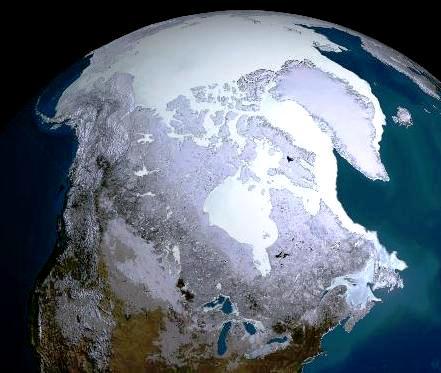
 Despite global warming and climate change, recent statements by NOAA's Pacific Marine Environmental Laboratory (PMEL) point towards a future of more cold and snowy winters (in other words, the potential for patterns to evolve similar to that of this past winter) for Europe, eastern Asia and eastern North America.
Why the claim? El Niño and the North Atlantic Oscillation (NAO) aside, the exceptional cold and snowy winter of this past year in the above-mentioned regions, is connected to unique physical processes in the Arctic. The Arctic is warming more than twice as fast as the rest of the planet. This is known as Arctic amplification, and these changes are happening a great deal faster than the scientific community expected.
It seems a warmer Arctic climate and a loss of sea ice is influencing the air pressure at the North Pole and shifting wind patterns, allowing for the disruption of the memory and stability of the Arctic climate system. This will be an important driver of major change in the world's climate system in the years to come and will likely be seen first across the mid-latitudes.
Experts say that given the recent reduction of the area of multi-year sea ice and reduced ice thickness, it is unlikely that the Arctic can return to its previous condition.
 Last year, a study using data from a NASA satellite showed that Arctic sea ice thinned dramatically between the winters of 2004 and 2008.Now – a couple years later, in its first dedicated oceanographic field campaign, more than 40 NASA scientists are heading to the Arctic to further study the impact of climate change. Their five-week expedition, dubbed ICESCAPE (Impacts of Climate on Ecosystems and Chemistry of the Arctic Pacific Environment), kicks off next Tuesday (June 15) aboard a U.S. Coast Guard icebreaker, and will focus on how varying physical, chemical, and biological ice conditions affect the ecosystems in the Chukchi and Beaufort Seas. These Seas and the Arctic Ocean, unlike others, is almost completely landlocked, making it an ideal location to study ongoing climate changes in a marine ecosystem already heavily impacted by declining sea ice cover, ocean acidification, and an increase in incoming solar radiation.NASA’s findings will ultimately help supplement the above-mentioned data that its satellites have for years collected on arctic ice (and ice-free) conditions.A follow-up voyage is scheduled for the fall of 2011.
 A recent study confirms that weather in part of the Arctic is becoming more unpredictable – a claim verified by Inuit elders and hunters. According to the large population of Arctic natives, the weather is not just getting warmer, it's getting weirder.
Specific climate change research in the Arctic region began as an attempt to reconcile differences between what Inuit’s were saying about their weather and what scientists were recording. Inuit hunters used to be able to count on stable weather, but were increasingly complaining that conditions were swinging wildly from day to day, making their traditional prediction skills less useful and endangering them on the land. However, such anomalies weren't showing up in the long-range studies developed by researchers.
In trying to understand the difference, the weather in two Nunavut communities – Baker Lake and Clyde River – were examined for short-term, day-to-day variability. Inuit hunters said that the greatest unpredictability was in June's spring weather. Therefore, a study was conducted that combined weather information from detailed, lengthy hunter interviews together with hourly temperature logs dating back more than 40 years. The two information sources backed each other up. Likewise, a statistical analysis showed that in the 1960s, June weather persistence was about 80 percent of the maximum rating. By the turn of the millennium, persistence had dropped as low as 20 percent. The conclusion made was that the weather itself isn't necessarily outside the normal range, but the speed with which it changes is.
This is not the first time scientists have turned to native people for information. NOAA has twice changed its report of the Arctic's whale population based on indigenous people’s report that revealed more whales than counted by the government.
The Arctic could be ice-free by summer 2035
NOAA reports the Arctic is losing summer sea ice faster than originally anticipated – by as much as 30 years! With computer models predicting the planet's coldest water refuge could be ice-free within 25 years from now, coastlines could be at major risk due to rising sea level.
Although there is considerable variability in computer model predictions, many show an accelerating decline in the summer minimum sea ice extent during the 21st century, and satellite images prove this trend is already underway.A new study by the Japan Agency for Marine-Earth Science and Technology, tells that contrary to popular belief, much of the record breaking loss of ice in the Arctic in recent years is a result of the region's swirling winds and is not a direct result of global warming. Even so, the Arctic is warming at twice the rate of the rest of the world.
Watch this!

 Despite global warming and climate change, recent statements by NOAA's Pacific Marine Environmental Laboratory (PMEL) point towards a future of more cold and snowy winters (in other words, the potential for patterns to evolve similar to that of this past winter) for Europe, eastern Asia and eastern North America.